


The Painful Experiences of the “Wolf Children” Come to Life: A Traveling Exhibition Opens at the Centre for Civil Education
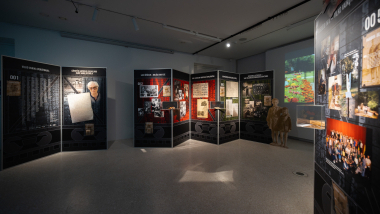
Who were the “wolf children”? The unusual name often prompts questions. From 21 January, the Centre for Civil Education is hosting the travelling exhibition “Wolf Children (Little Germans): The Forgotten Story of the Children of the Second World War,” prepared by the public institution Atminties tiltai (“Bridges of Memory”). Through historical photographs, documentary materials, and personal testimonies, the exhibition reveals the tragic fates of children from East Prussia who sought refuge in Lithuania.
For the German population of East Prussia, the end of the Second World War was catastrophic. A failed evacuation to the West, violence and abuse, epidemics, and postwar famine forced many to flee to Soviet Lithuania. Beginning in the spring of 1945, German children travelled to Lithuania on foot, by train, or in horse-drawn carts in search of food and safety. For many, survival came at the cost of losing their native language and identity, yet their faith in humanity endured.
“Marked by the unimaginable horrors of the Second World War, alone, hungry, and afraid – these children set out for a foreign country whose language they did not understand and whose culture was unfamiliar to them. And yet for many, it became a path to survival. Because here, in Lithuania, there were people who, despite the dangers, opened not only their doors but also their hearts,” says the German Ambassador to Lithuania, Dr. Cornelius Zimmermann.
Visitors are invited not only to explore the exhibition but also to engage with it actively. For the first time at the Centre for Civil Education, historical and documentary material is presented alongside the film The Ancient Woods (Sengirė) by Mindaugas Survila. “When we speak about the wolf children, we are not only speaking about the past – we are reflecting on what it means to remain human when the world collapses. In the exhibition, we combine historical material with The Ancient Woods film because nature became a means of survival for many of these children – the forests fed them, sheltered them, and helped them endure,” says the exhibition’s initiator and curator, historian Rūta Matimaitytė.
“The exhibition, initiated and created by Rūta Matimaitytė, is profoundly relevant not only from a historical and humanistic perspective, but also in light of the tragedies shaking the world today. I hope it will inspire visitors not only to reflect on the past, but also to stand firmly in defence of truth in the present,” says the exhibition’s artist, Saulius Valius.
The exhibition will remain open at the Centre for Civil Education until 29 March.